The Hidden Cost of Top-of-Funnel Content for Post-PMF SaaS
I’ve watched post-PMF SaaS teams grow traffic while deals quietly slowed down. Marketing looked healthy. Sales felt friction. No one was wrong — but the content strategy was stuck in an earlier stage of the company. This article breaks down why over-investing in top-of-funnel content after PMF creates funnel imbalance, longer sales cycles, and decision-shy buyers — and what to do instead.
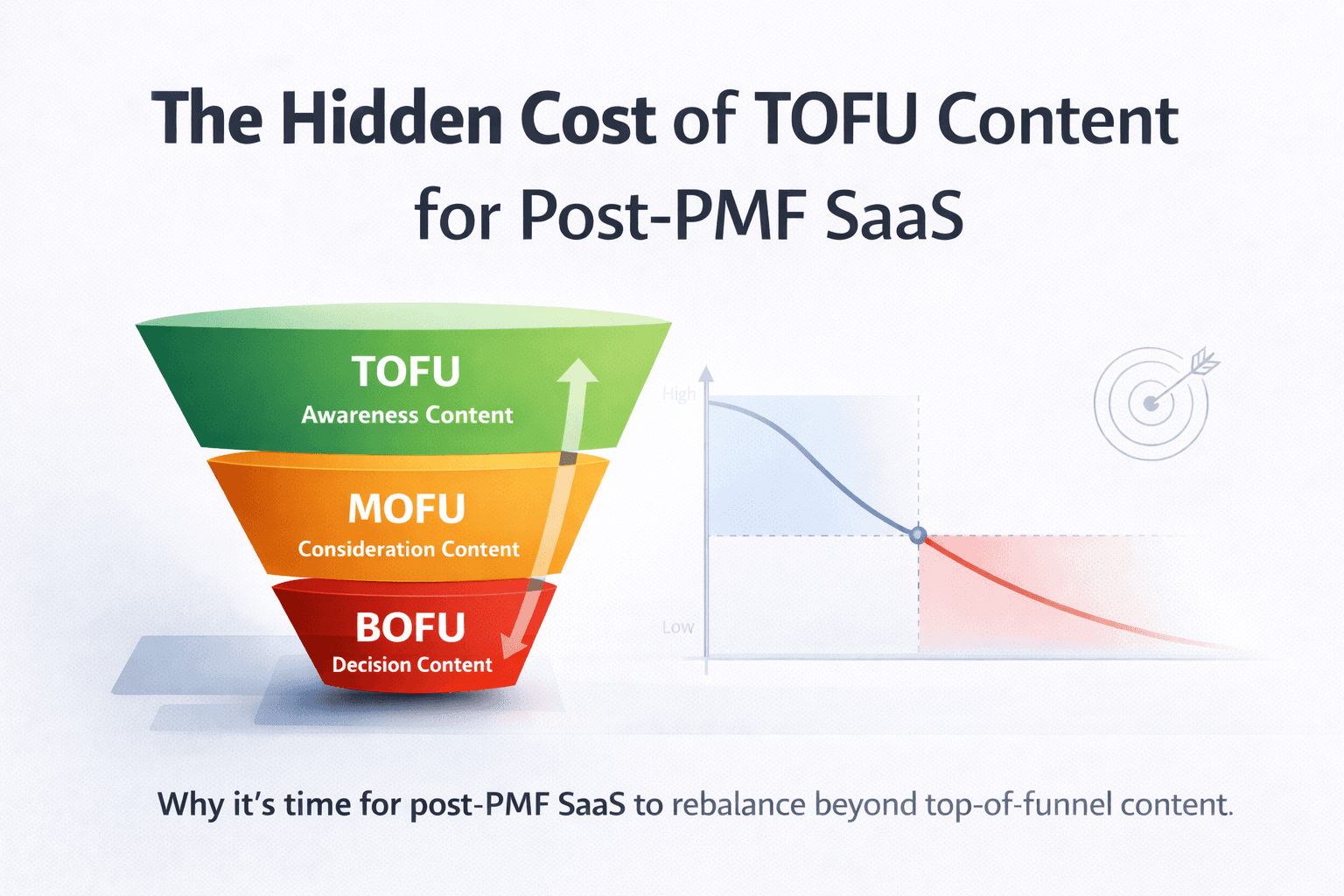
Post-PMF SaaS content funnels show diminishing returns from TOFU content. Balancing MOFU and BOFU ensures buyers move faster and deals close more efficiently.
The Hidden Cost of Top-of-Funnel Content for Post-PMF SaaS
There’s a meeting I’ve sat through more than once.
Marketing pulls up the dashboard. Traffic is up. Newsletter signups are healthy. A few blog posts are ranking well. On paper, things look… fine.
Then sales speaks.
Deals feel slower. Prospects are more cautious. Conversations drag. “Interested” doesn’t turn into “decided” the way it used to.
No one is lying. No one is incompetent. And yet, something is clearly off.
If you’re post-PMF, this moment probably feels familiar. And if it does, there’s a good chance your content strategy is quietly working against you — not because it’s bad, but because it’s stuck in an earlier phase of the company.
Most SaaS blogs don’t fail because they under-invest in content. They fail because they keep investing in top-of-funnel content long after it stops pulling its weight.
Why TOFU content hangs around longer than it should
I understand why this happens. I really do.
Top-of-funnel content feels responsible. Safe. Productive. It gives you numbers you can point to when things feel uncertain.
I’ve leaned on it myself — especially when the questions downstream were harder to answer.
The problem isn’t that TOFU content is useless after PMF. It’s that its marginal value drops, while its comfort stays high.
Before PMF, TOFU answers a critical question:
“Is there demand here at all?”
After PMF, that question is mostly settled. What replaces it is quieter, more uncomfortable:
“Can we consistently turn interest into revenue — without brute force?”
TOFU content doesn’t answer that. And if you keep treating it like the engine, you start paying hidden costs elsewhere.
The cost you don’t see in analytics
This isn’t about “wasted traffic.” That framing is too shallow.
The real cost shows up in places dashboards don’t capture well.
You attract attention but don’t help momentum
Post-PMF buyers don’t need to be convinced the problem exists. They’re already living with it.
What they’re unsure about is:
- Which approach actually works at their scale
- What tradeoffs they’re signing up for
- Whether choosing you is defensible internally
When your content stops at education and never moves into decision, your best buyers end up doing the hardest thinking alone.
That’s not neutral. It slows things down.
Sales ends up redoing work content should have handled
Here’s a quiet signal I pay close attention to:
If your sales team is constantly creating their own decks, one-pagers, Looms, or Notion docs — your content strategy is misaligned with revenue.
They’re not doing this because they enjoy it. They’re doing it because the buyer shows up underprepared for the conversation that actually matters.
I still remember the first time a sales rep told me, flat out, “None of this content helps me close.”
My instinct was to defend the work. They weren’t wrong.
You train buyers to stay in research mode
Helpful content is good. But being helpful without direction can be dangerous.
Too much TOFU content teaches buyers to:
- Keep consuming instead of choosing
- Stay curious instead of committed
- See you as a resource, not a reference point
At some point, more information stops reducing risk, and starts delaying decisions.
Post-PMF buyers don’t need more answers. They need fewer, sharper ones.
How funnel imbalance sneaks in (without anyone choosing it)
Almost no one intentionally says, “Let’s ignore MOFU and BOFU.”
It happens because TOFU content:
- Is easier to brief
- Is easier to outsource
- Rarely upsets anyone
- Rarely sparks internal disagreement
The closer you get to revenue, the more content requires:
- Clear ICP conviction
- Sales alignment
- Willingness to take a position
So teams drift upward in the funnel. Quietly. Gradually.
Here’s a question worth sitting with:
If a serious buyer read only your website, could they confidently choose you, and explain why?
If the honest answer is “maybe not,” that’s not a traffic problem.It’s a funnel imbalance.
Rethinking TOFU, MOFU, and BOFU through a revenue lens
After PMF, content strategy shouldn’t map to marketing stages. It should map to buyer progress inside real deals.
Here’s the reframing that tends to unlock things.
Awareness: “Is this problem worth solving now?”
You still need this layer. Just not endlessly.
This is where TOFU content belongs:
- Market shifts
- Cost of inaction
- New constraints buyers are feeling
But it should be contained.
A simple rule I’ve seen work: TOFU should not grow faster than revenue.
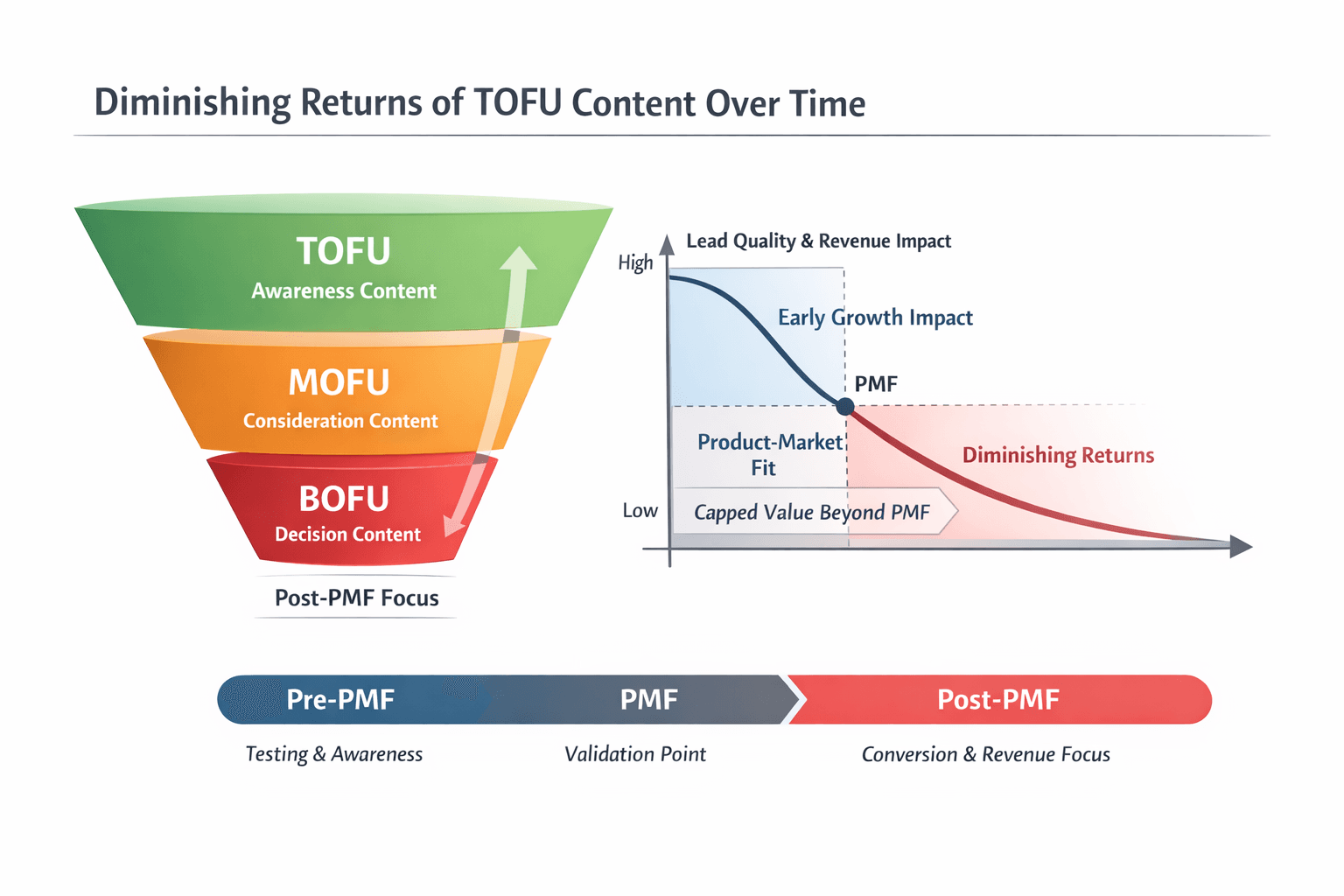
A funnel diagram showing diminishing returns of TOFU over time.
Consideration: “Why this approach over the others?”
This is where most post-PMF SaaS companies under-invest, and pay for it later.
Buyers are actively comparing:
- Status quo vs change
- Build vs buy
- Category A vs category B
If you’re not helping frame those comparisons, someone else is.
Strong MOFU content does things like:
- Explain tradeoffs honestly
- Reframe alternatives
- Clarify when your approach isn’t right
This is the content that makes sales calls feel easier, before they happen.
Decision: “Can I defend this choice?”
This is BOFU content most teams say they want… and rarely prioritize.
This isn’t glossy case studies. It’s decision support.
Think:
- Objection-handling content
- Use-case-specific narratives
- ROI logic buyers can reuse internally
If your buyer has to invent the justification themselves, you’ve already added friction.
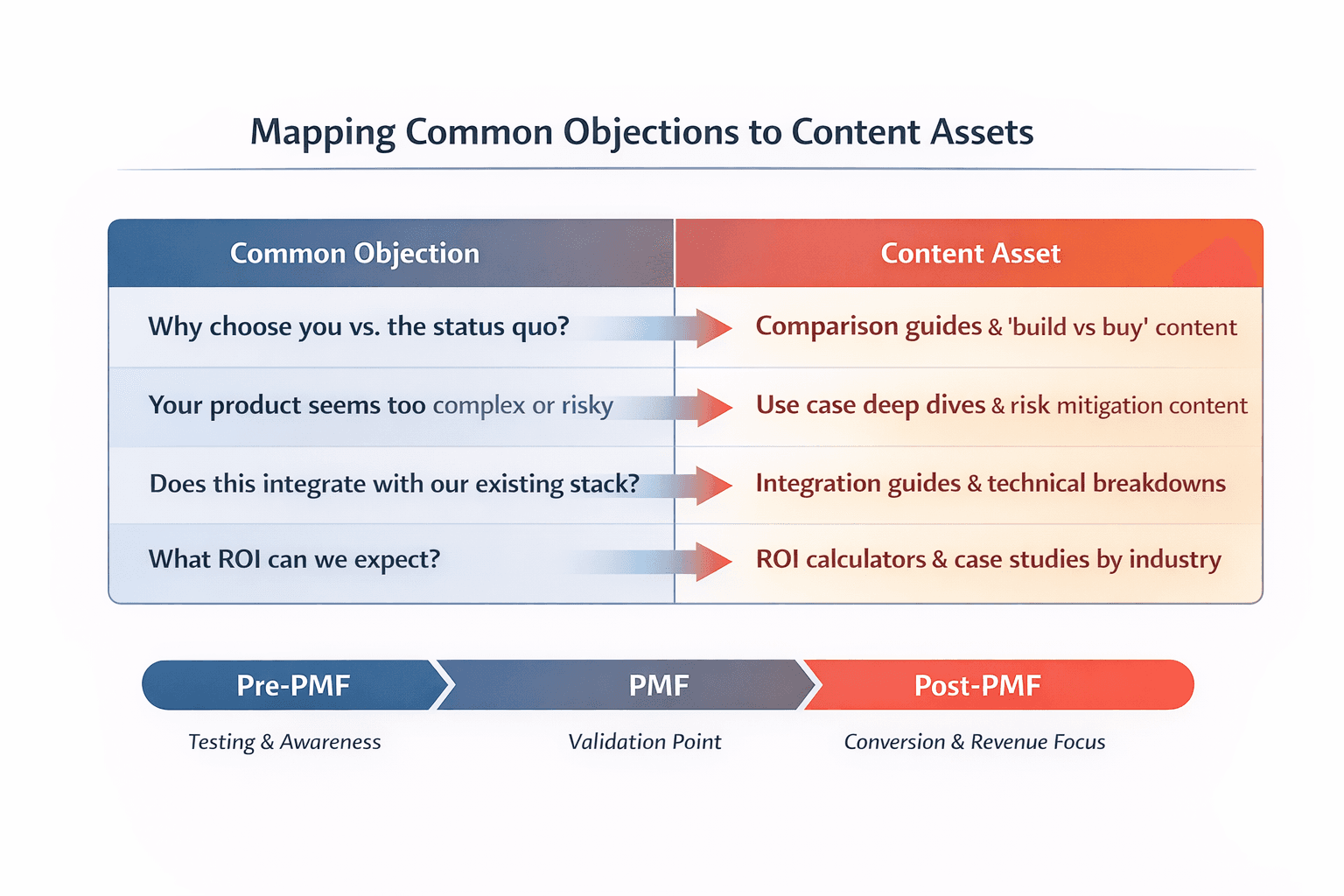
Table mapping common objections → content assets.
What mature post-PMF teams actually do
They don’t kill TOFU. They rebalance.
Here’s what I consistently see from teams that get this right.
They cap TOFU intentionally
Not dogmatically — deliberately.
Often something like:
- 30–40% awareness
- 40–50% consideration
- 20–30% decision
The exact mix matters less than the intent behind it.
They build content sales actually trusts
This requires real conversations.
Not “what content do you want?” But:
- Where do deals slow down?
- What objections keep resurfacing?
- Where do buyers lose confidence?
Then turning those answers into public assets.
If it feels a little too honest for marketing, it’s probably useful.
They measure content by movement, not consumption
Traffic still matters. But it stops being the hero metric.
More telling signals:
- Which assets show up in closed-won deals
- Time-to-decision
- Sales cycle length by content consumed
That’s revenue literacy in practice.
The part no one enjoys talking about: pruning
Some TOFU content doesn’t just underperform — it actively muddies the waters.
Examples I’ve seen cause real confusion:
- “What is X?” articles attracting beginners your sales team can’t serve
- Broad thought leadership with no product POV
- Educational pieces misaligned with your actual ICP
At a certain stage, clarity beats coverage.
Sometimes the most strategic content decision isn’t what to publish next — it’s what to quietly retire.
A practical way to rebalance without blowing things up
If you’re wondering where to start, here’s a simple 90-day approach I’ve seen work.
Month 1: Map reality
- Assign each existing piece to a deal stage
- List sales objections with no content support
- Flag TOFU content with zero downstream impact
Month 2: Fill the gaps
- Publish a small set of strong MOFU pieces
- Create 1–2 real decision-support assets
- Update existing TOFU with clearer next steps
Month 3: Align and observe
- Show sales how to use content intentionally
- Track what appears in successful deals
- Adjust based on buyer behavior, not habit
No heroics. Just alignment.
A closing thought, from experience
Post-PMF content isn’t about saying more. It’s about removing decisions, not adding them.
If your content library keeps growing but deals don’t move faster, it’s usually not a talent problem or an effort problem.
It's the focus.
And more often than not, it’s too much top-of-funnel content — long after it stopped being the bottleneck.
After PMF, the costliest content mistake isn’t being invisible. It’s being visible without being decisive.
Written by Eliud Mbugua
Content Marketing Strategist & Writer | Helping Tech Founders Communicate Value & Attract Ideal Customers